Showing posts with label news. Show all posts

Sunday, June 12, 2011 10:47 PM

Death upheld for Kuwait woman for wedding carnage - Yahoo! News

KUWAIT CITY (AFP) – Kuwait's supreme court on Sunday upheld a woman's death sentence for setting ablaze her husband's wedding tent, killing 57 women and children.
Nasra Yussef Mohammed al-Enezi, 24, was condemned to death by a lower and appeals courts for the apparent act of revenge against her husband for taking a second wife.
Under Islamic laws, men in Kuwait can take up to four wives at a time.
The ruling against Enezi is final unless the emir commutes the sentence to a life term. Death sentences in the oil-rich Gulf state are carried out by hanging.
Enezi, who has two mentally-ill children from her husband, denied the charges throughout the trial and her defence lawyers argued there was no material evidence to convict her.
The August 15, 2009 inferno engulfed the women-and-children-only tent in minutes and triggered a stampede. The final death toll was 57, including Saudis and stateless Arabs.
If Enezi is hanged, she would be the first Kuwaiti woman to be executed in the Gulf state's history. Three foreign women have been hanged.
Kuwait has executed a total of 72 people since it introduced the death penalty some four decades ago. Most of those condemned have been convicted murderers or drug traffickers.
The last execution in the emirate dates back to mid-2007 although dozens of convicts are on death row.

Death upheld for Kuwait woman for wedding carnage - Yahoo! News

10:32 PM

Death Penalty News: China executes student over hit-and-run murder

BEIJING —China on Tuesday executed a music student convicted of stabbing a woman to death after hurting her in a car crash, a crime that sparked national debate over China's "rich second generation."

Yao Jiaxin was executed after the high court in north China's Shaanxi province turned down his appeal over the April 22 death sentence, China Central Television reported.

The execution was also approved by China's Supreme People's Court, which noted the "extremely despicable and odious" nature of the crime, the Xinhua news agency reported.

Yao, 21, was convicted of murdering 26-year-old mother Zhang Miao on October 20 after hitting her with his car on the streets of the provincial capital of Xian.

Zhang, who was riding her bike, only suffered minor injuries in the accident but instead of helping the woman, Yao stabbed her eight times with a knife as she eyed his car number plate.

Yao, a student at the Xian Conservatory of Music, fled the scene but was later caught and, according to an earlier Xinhua report, confessed that he killed her because he feared the "peasant woman would be hard to deal with" over the accident.

The crime has prompted hand-wringing over the country's so-called "rich second generation."

The term is applied to the wealthy offspring of people who have prospered with China's economic opening of the past 30 years -- youths seen as expecting privilege and sometimes lacking in morals.

It follows another notorious incident involving a 23-year-old man, Li Qiming, who was sentenced to six years in prison in January after attempting to exploit his father's senior police rank to flee a fatal drink-driving accident.

After running over two young women on a college campus in north China, killing one, he shouted, "my father is Li Gang," and dared onlookers to try to stop him leaving the scene.

News reports said Yao's family was neither especially wealthy nor well connected, but that both his parents worked for companies in China's defence industry, which has boomed in recent years as the country has rapidly modernised its military.

Reaction to Tuesday's execution on the Chinese Internet was mixed, with some saying Yao's actions could be the result of the huge pressure to succeed heaped on many youngsters by their parents, sometimes at the expense of moral values.

"He shouldn't have been killed, what a pitiful kid. Why can't we have a little compassion -- this entire episode has been good for neither family," said a posting from a sina.com user in south China's Guangdong province.

Another user from the eastern province of Shandong identified as Fenfang said: "What good is a college student if they cannot have just a little bit of humanity? The execution of Yao Jiaxin is a necessary result of the crime."

Death Penalty News: China executes student over hit-and-run murder

Friday, June 3, 2011 9:22 AM

SRK takes on Ramdev, says fast politically motivated - Yahoo! News

Shahrukh Khan during filming at Kennedy Space ...Image via Wikipedia
Indore, June 2 (ANI): Bollywood actor Shah Rukh Khan on Thursday said yoga guru Baba Ramdev's proposed hunger strike against corruption is politically motivated, and added that he would not support the agitation.
"I do not know what his agenda is. As soon as somebody gets embroiled in politics and becomes a political leader, I think they develop their known way of thinking. I think what they are saying is very good, but if you have a political party, I am apolitical by nature. So I don't align myself. I think he has a political party now," Shah Rukh Khan told reporters here.
"This has been said for years, remove black money, corruption needs to be going out, and if this is one way of looking at it, wonderful, something is being done. But as far as I am concerned, I like to make an opinion through my work because everyone should do what they are supposed to do," he added.
Asserting that black money stashed abroad should be declared a national property, Ramdev earlier today remained firm on going ahead with his fast to demand urgent steps to curb corruption.
"The black money stashed abroad should be declared national property, and keeping black money should be considered a crime at par with sedition. We are not staging any protest or rebellion," he told reporters here.
Ramdev also rubbished reports of differences with veteran social activist Anna Hazare.
"I talked to Anna Saheb before coming here, there are no differences, we were together and we are together," he added.
Meanwhile, Anna Hazare announced that he will take part in Ramdev's movement against black money and corruption.
"I will join Baba Ramdev on June 5. I will sit with him on the dais and discuss many issues. If we all get together, then the government will have to concede to our demands," he told reporters in Ralegoan, Maharashtra.
Hazare made it clear that there is unity among civil society members and the perception that Ramdev is upset about the inclusion of father-son duo of Shanti and Prashant Bhushan in the Lokpal Bill drafting committee is in correct.
Union Home Minister P. Chidambaram on Wednesday said the next round of talks between the government and Baba Ramdev will be held on Friday to further discuss the latter's proposed hunger strike plan.
"I am told that they have agreed to meet again on June 3 to continue the discussions and I will advise everyone to observe restraint," said Chidambaram.
The government had earlier deputed Urban Development Minister Kamal Nath and Central Board of Direct Taxes (CBDT) Chairman Sudhir Chandra to persuade Baba Ramdev not to undertake the agitation, but the effort failed.
Ramdev announced his decision to go on a fast over the black money issue last month. He is demanding that black money stashed away in safe havens abroad be brought back to India. (ANI)

SRK takes on Ramdev, says fast politically motivated - Yahoo! News

Friday, May 27, 2011 2:13 AM

Should a baby's gender be kept a secret? - The Week

A Canadian couple isn't telling whether their 4-month-old baby is a boy or a girl. Will that foster personal freedom, or just create confusion?

Best Opinion: Babble, Fox News, NY Times


Two Canadian parents are making headlines, and courting controversy, for attempting to raise a genderless baby. Kathy Witterick gave birth to baby Storm four months ago, but she and her husband, David Stocker, have yet to proclaim "It's a boy!" or "It's a girl!" Rather, they're keeping Storm's gender a secret, telling friends and relatives "we've decided not to share Storm's sex for now — a tribute to freedom and choice in place of limitation." The only other people who know Storm's sex are his or her two young brothers, the two midwives who helped in the delivery, and one close family friend. Will this secret allow Storm to duck society's gender expectations, or just confuse and damage the kid?

What a compelling idea: "It's a fascinating experiment," says Madeline Holler at Babble. While keeping the baby's gender a secret sounds like a big hassle — I certainly wouldn't try it — the uproar over this decision, and "the fact that people get emotional about it, proves the parents' point." Strangers shouldn't care what gender this baby is, and really, it shouldn't be of such great import to anyone outside the family's inner circle. Pronouns aren't worth getting worked up about.
"Is it a boy or girl? This 4-month-old's family isn't saying"

This will only confuse the poor kid: "These parents might be doing the wrong thing by their child," says Dr. Manny Alvarez at Fox News. I'm all for letting children make choices about their gender identity and sexual orientation, but this seems like the wrong way to go about it. "The parents are introducing undue doubt from the beginning of the child's life, which may lead to an entirely new form of identity crisis — the crisis of not being able to identify with any gender at all."
"Are parents creating a gender identity crisis in 4-month-old?"

Not to mention harming Storm's siblings: What about the genderless baby's older brothers? asks Lisa Belkin in The New York Times. I worry about the message they're getting, with their new sibling's gender being treated as an "unspillable secret." "Doesn't that in itself give gender the all-defining importance that these parents are trying to avoid?"
"Is this baby a boy or girl?
Should a baby's gender be kept a secret? - The Week

Monday, May 23, 2011 6:46 AM

DSK house arrest site a new tourist hot spot - CBS News

"Classic" logo of CBS News, from the...Image via Wikipedia
DSK house arrest site a new tourist hot spot - CBS News

Saturday, May 21, 2011 9:53 AM

Suicide bomber kills at least 6 in Kabul hospital | Reuters

(Reuters) - A suicide bomber killed at least six people and wounded 23 more at a military hospital in a heavily guarded area of Kabul on Saturday, security officials said, the worst attack in the Afghan capital in months.

The bomber struck at 12:30 p.m. local time (5 p.m. EDT) in the cafeteria of the hospital where medical students were eating lunch, said Mohammad Zahir, head of the police crime investigation unit. He said the dead were students.
The hospital is in a high-security area near the U.S. embassy where several other foreign embassies and international organizations operate.
Taliban spokesman Zabihullah Mujahid said in an emailed statement the group had sent two suicide bombers into the hospital and killed many. The Taliban launched a long-awaited "spring offensive" last month.
Afghan President Hamid Karzai and the NATO-led International Security Assistance Force (ISAF) condemned the attack.
"This attack on an Afghan hospital where sick and injured people are being treated is abhorrent and represents the lowest, most cowardly attack," ISAF said in a statement.
The United Nations mission in Afghanistan (UNAMA) said attacks on medical workers and hospitals are prohibited under international humanitarian law.
"Directing an attack against a zone established to shelter wounded and sick persons and civilians from the effects of hostilities is also illegal and prohibited," UNAMA said in a statement.
Despite escalating violence in the 10th year of an increasingly unpopular war in Afghanistan, Kabul has been relatively peaceful in recent months.
In early April, a suicide bomber attacked an Afghan army bus on the outskirts of the capital, wounding 10 soldiers and civilians.
In January, a suicide attack on a supermarket frequented by foreigners killed nine people in the embassy district of Kabul.
The Taliban, which often inflates the number of casualties it inflicts, vowed last month to carry out attacks, including suicide bombings, on foreign and Afghan troops and government officials.
Despite the presence of up to 150,000 foreign troops, violence across Afghanistan is at its worst since the 2001 overthrow of the Taliban government by U.S.-backed Afghan forces. Last year both sides suffered record casualties.
(Writing by Amie Ferris-Rotman; Editing by Andrew Heavens)

Suicide bomber kills at least 6 in Kabul hospital | Reuters

Thursday, May 19, 2011 9:23 PM

Paralysed baseball star steps into medical history | World news | The Guardian

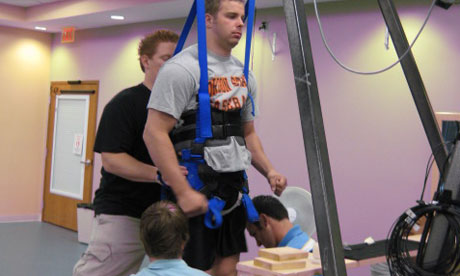
Baseball champion Rob Summers was hit by a speeding car in Portland, Oregon, three years ago, which smashed into his legs and left him with appalling injuries. He was told he would spend the rest of his life in a wheelchair at best. But the 25-year-old is now making history – as the first person paralysed from the chest down to stand and take a step unaided.
The small and shaky movements that Summers has achieved spell real hope for all those who have suffered a spinal cord injury, and possibly even for those paralysed by other causes such as stroke.
When he was in hospital, doctors told Summers he would never walk again, he said. "They said that I had no hope and to just give up. My comment was you don't know me very well. I'm going to fight until I get well again." To stand again and take steps, he said, "felt incredible. It was amazing. It made me optimistic and hopeful again for the future. I'm excited at being a part of this."
Summers' legs are able to move because of electrical stimulation from a device implanted in his lower spine. Two hard years of training, suspended over a treadmill with physiotherapists manipulating his legs to stand and walk have helped build up the spinal cord neural network which processes signals to and from his legs.
The real discovery has been that it is not the brain that is in charge of movement, but the legs and the spinal cord.
His achievement is the culmination of many years of hard work and intense scientific endeavour funded by the Christopher and Dana Reeve Foundation, set up to try to find a way to restore movement to the former Superman star Christopher Reeve – who was paralysed in 1995 as the result of a riding accident – and others like him.
Summers, a college baseball player for Oregon state who had helped his team win the college world series just six weeks before the hit and run driver wrecked his life, was exceptionally fit when he was injured.
Although unable to move any part of his legs or feet, he has some residual feeling. This may mean that the astonishing progress made in his case may not be replicable in everybody. But there is now more than hope.
"This is a breakthrough. It opens up a huge opportunity to improve the daily functioning of these individuals ... but we have a long road ahead," said Professor Susan Harkema from the Kentucky spinal cord research centre at the University of Louisville, one of two leading neurologists involved in Summers' treatment.
Harkema describes the impulse from the brain to start walking as "facilitatory". What really starts the walking process, she says, is probably the shifting of weight to one foot.
"The brain is not controlling movement to the extent we thought it was. If you think about walking, it sets up the nervous system to expect information related to walking," she said. That sensory information comes from the legs.
This has been known and accepted in animals for some time, she added, but it was thought it might not be so in humans because of the highly developed brain.
"The spinal cord is smart," said Harkema's chief collaborator, neurologist Professor V Reggie Edgerton from the David Geffen school of medicine at UCLA.
"The neural networks in the lumbosacral spinal cord are capable of initiating full-weight bearing and relatively coordinated stepping without any input from the brain. This is possible, in part, due to information that is sent back from the legs directly to the spinal cord."
The details of the neurologists' work with Summers are published in the Lancet medical journal.
The results need to be replicated in other patients and the neurologists also hope to work with paralysed patients with other kinds of injury. But, said Susan Howley, executive vice president for research at the Reeve Foundation, it demonstrates proof of concept. "It's an exciting development. Where it leads from here is fundamentally a matter of time and money," she said.
Other neuroscientists applauded the work in a commentary in the Lancet. Dr Grégoire Courtine and Dr Rubia van den Brand from Zurich University and Dr Pavel Musienko from St Petersburg wrote that they expected "this novel phenomenon of electrically enabled motor control" would inspire new thinking. They added: "We are entering a new era when the time has come for spinal-cord injured people to move."
Meanwhile, Summers hopes to run and play baseball again one day. It has been, he acknowledged, "one great emotional rollercoaster with highs and lows. There were points of anger and frustration, but I would refocus on my goals." His family, he said, had been incredibly supportive.
He hopes now to make a movie. "My goal is that through making a movie of my life story, I will help the millions of people around the world, paralysed and in wheelchairs, who have lost hope, and show them there is a brighter future ahead."

Paralysed baseball star steps into medical history | World news | The Guardian

9:16 PM

Egypt's Muslim Brotherhood poised to prosper in post-Mubarak new era | World news | The Guardian

Islamist movement banned under Mubarak regime will compete in forthcoming parliamentary and presidential elections, but more radical groups are also gaining political ground


It's hard to miss the new headquarters of the Muslim Brotherhood in the Cairo neighbourhood of Moqattam – six stories towering over the dusty street with the distinctive Qur'an and crossed swords symbol emblazoned on the stucco facade. The decor is a medley of parquet floors, crystal chandeliers, swagged velvet curtains and gilded furniture.
In the lobby a team from the brotherhood's fledgling TV station is interviewing a bigwig as a sharp-suited, clean-shaven aide hovers fussily.
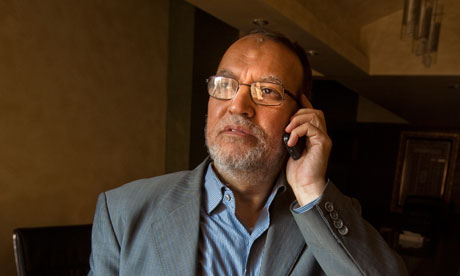
"After 100 days we are sure the revolution is on the right track," beams Issam el-Erian, the articulate and experienced spokesman for the organisation known in Arabic simply as the Ikhwan. "In a few months we will have a new parliament and then a new constitution for the new Egypt."
The Moqattam HQ is a striking improvement on the brotherhood's shabby old premises in a downmarket Nile-side suburb – a reminder of the long years when it was banned, its activists routinely harrassed, detained and tried in military courts and aspiring MPs forced to stand as independents.
Now, everything exudes self-confidence and a sense that the world's oldest Islamist movement, which has long embraced democracy and eschewed the violence of the past, is poised to prosper in the post-Mubarak era. It is even planning to set up football teams to compete in the country's professional leagues, prompting silly jokes about yellow cards for any pulling of beards.
Erian and two other senior figures have resigned from the leadership to found the Freedom and Justice party (FJP) to compete in September's elections – Egypt's first free vote since the 1952 revolution. The new party and the 83-year-old Muslim Brotherhood have "the same mission and goals, but different roles", he explains.
Predictions range from the FJP becoming the dominant force in the new parliament to capturing around 20% of the seats because, the argument goes, in a multi-party democracy its old anti-regime appeal will be weakened.
The brotherhood did not organise the Tahrir Square protests, but backed them when the regime was teetering. It is careful now to avoid appearing too ambitious or threatening. It says the FJP will field candidates for up to 50% of parliament and, crucially, none for next year's presidential race (though an independent candidate, Abdel-Moneim Abul Fotouh, does come from a reformist brotherhood background). "It is not the time for decisions," Erian added. "This is the time to be united and move Egypt from dictatorship to democracy."
But Muntasser al-Zayyat, a prominent Islamist lawyer, believes the Ikhwan could end up controlling as much as 60% of parliament – because their secular and liberal rivals are divided and far less experienced than ex-members of Mubarak's now disbanded National Democratic party, who are likely to stand as independents in their old constituencies.
Opponents say they expect a poor showing because of the brotherhood's internal divisions and a wide generation gap, arguing too that the old regime and foreign governments both exaggerated its coherence, importance and the danger that it could to lead to an Iranian-style Islamic state on the Nile. Its assiduous grassroots work – providing social services, clinics and schools to fill the gaps left by a profoundly rickety state – is considered far more important than any overtly political activity.
"I would not like the brotherhood to come to power but it is good that they have entered the political arena," said Mona Makram-Ebeid, a former MP for the liberal Wafd party. "It was ridiculous to call them 'the banned' when they won 88 seats in the 2005 elections. That gave them a mystique. Once you incorporate them you demystify them."
Shrugging off suggestions of wishful thinking, Hani Shukrullah, the veteran al-Ahram journalist, agrees: "The brotherhood will not be the same any more. The ideal environment for them was authoritarianism but in a pluralistic political space it will be a struggle of programmes and agendas, not of ideology or religion."
Yet Egyptian liberals, leftists and Christians may face a far bigger problem than the Ikhwan with the resurgence of fundamentalist Salafis – "Egypt's Taliban," one intellectual bluntly calls them. The group, which follows a literal interpretation of the Qur'an, were repressed under Mubarak and were linked ideologically to violent groups such as the (now reformed) Gama'a Islamiya (Islamic Group).
Abboud al-Zumar, who served a 30-year prison sentence for his role in the assassination of President Anwar Sadat in 1981, is one of several Salafis who have been released from detention in recent weeks. He was in jail with Ayman al-Zawahiri, Osama bin Laden's Egyptian deputy. Hundreds more are reported to have been quietly allowed to return to Egypt from abroad.
In addition, liberals claim, the army has sought the help of leading Salafis, such as Sheikh Muhammad Hassan, to preach coexistence and reconciliation after sectarian violence instead of confronting them. In April, Salafis were blamed for blocking railway lines in protest at the appointment of a Christian governor in the Upper Egypt province of Qena. It took last week's incident in the working-class Cairo suburb of Imbaba, in which 12 people were killed after an attack on a Coptic church, to trigger a harsh response.
Islamists complain they are being deliberately demonised. "The Salafis have become a scarecrow," argued Zayyat. "It used to be the brotherhood. Now the secularists are using the Salafis to attack the Ikhwan." The brotherhood, in turn, accuses its enemies of smearing them by conflating them with the Salafis. "Those who fear us do not know us," said Ali Abdel-Fatah, a brotherhood leader from Alexandria, Egypt's second city. "And some journalists try to confuse us with stricter religious groups."
Salafis insist their priority remains Da'awa (preaching), aided by popular preachers, TV shows and websites funded by Saudi Arabia, home to the related Wahhabi doctrine of Islam. Until recently, Egyptian Salafis were more a school of thought than an organisation — "ignorant people who know nothing of the wider world," complains a fierce secular critic, Midhat al-Khafagy. But they are adjusting to the limelight and abandoning their traditional quietism for active politics. March's constitutional referendum was hailed by them as a "victory for religion". Now there are plans to form two brand new parties – Fadila and Nur (Virtue and Light) – for September's parliamentary elections.
"The old regime put a lot of pressure on us to stop our ideas spreading but now people can see how many Salafis there are," said a delighted Sheikh Abdel-Moneim al-Shahat, a leading Salafi spokesman from Alexandria, who has warned that a liberal constitution for the post-Mubarak era would be a "catastrophe" for Egypt.
"We want a democratic constitution but it should be in line with sharia law. We won't accept a Christian or a woman as president. The liberals want a democratic constitution but some of it would be against sharia, especially on issues of personal morality."
In a rapidly changing political landscape, none of this looks like becoming the Islamist takeover feared by secularists. But it seems clear the role of Islam in Egyptian public life is going to be bigger, in what Erian has called the "transition from pharaonic rule to people's rule."

Egypt's Muslim Brotherhood poised to prosper in post-Mubarak new era | World news | The Guardian

9:09 PM

The Osama opening - Opinion - Al Jazeera English

Despite Osama's elimination by US commandos, the US has a unique opportunity to correct the balance in the region.


The image, caught on home video, is a defining one: a hunched Osama bin Laden, in pathetic, lonely domesticity, with a grey beard and a blanket covering him like a shawl, surveying the television wasteland for images of himself. How banal this epitome of evil turned out to be.
That is why Osama's elimination by US commandos is such a marvellous case study. Start with this question: Was it poetic or divine justice that al-Qaeda's leader, whose group, born in Peshawar, Pakistan, in 1988, was fathered by Pakistan's Inter-Services Intelligence agency and midwifed by the CIA, was finally killed by his figurative creators?
This question leads to two more that are anything but rhetorical: Where, in the end, does the fault for bin Laden's murderous decades lie? And will his death mark the end of global jihadist terrorism?
To be sure, street protests and a chaotic clamour of recrimination have gripped Pakistan, while dire threats float in the internet ether and a bizarre indifference pervades the rest of the Muslim world. But events in the Maghreb and the Middle East seem to demonstrate that the streams of Arab and Muslim political life are flowing away from Osama's murderous messianism.
That is why the crucial test today is what happens tomorrow in Pakistan and Afghanistan. The future of Pakistan, peace in Afghanistan, normalcy in India-Pakistan relations, and economic progress in South Asia all hinge on whether bin Laden's death dilutes extremism and dissolves intolerance or re-concentrates both.
The history of the region's discord is a complex mix of ethnic, territorial, and existential fears, imaginary or real. But now that America's mission in Afghanistan has, at least symbolically, achieved its objectives, a new chapter must open. To persist with the old "reordering" of Afghanistan would be sheer folly, dissipating whatever good might come from the end of Bin Laden's blood-soaked career.
But the United States alone cannot bring peace to the region. A broader regional condominium, involving Afghanistan, Pakistan, India, China, Russia, and, yes, Iran, must be brought into play.
For this to happen, however, the first step must come from Pakistan. It must now renounce terrorism as an instrument of state policy; stop employing groups like Lashkar-e-Taiba as strategic reserves against India; and abandon aspirations of acquiring overweening influence over the government in Kabul.
Of course, Pakistan's concerns about Afghanistan are fuelled by a near-paranoid anxiety about India. This fear must be overcome, for the geopolitical challenge in Afghanistan is too great to allow such misbegotten apprehensions to persist.
Here, India bears a grave responsibility: it must assuage Pakistan's valid security concerns convincingly. After all, there is no solution in retributory, panic-ridden responses by Pakistan, or in chest-thumping schadenfreude elsewhere. Now is the moment for South Asia to revert to its "natural balance", gain breathing space, and recover its shattered peace.
To this end, and to facilitate a withdrawal of US and NATO troops from Afghanistan, the region's countries must create a credible template for reconciliation. The design for such a process cannot accommodate malevolently carnivorous forces like jihadist terrorism, which merely sucks credibility out of its principal progenitor, Pakistan.
Is this too idealistic, and thus unattainable? Perhaps, but the alternatives to doing nothing are infinitely worse: the continued condemnation of South Asia to the scourge of terrorism; almost one-third of humanity reduced to self-perpetuating penury; and a near-permanent US/NATO military presence, which would make Afghanistan (and Pakistan?) tantamount to a Western-controlled protectorate. Unless we accept our responsibility, more "Abbottabads" will surely follow.
Of course, no one questions Pakistan's sovereignty. But both its identity and faith in its word are now doubted by almost everyone outside the country. Surely we can caution its people that they are sliding towards Talibanisation, and that this threatens to tear their country apart?
Pakistani president Asif Ali Zardari proclaims that the war on terror is Pakistan's war too, and that the country has paid a high price in waging it - not only the thousands of Pakistani soldiers and policemen killed, but also in terms of social progress foregone. But that is all the more reason why Pakistan must act now - if only to save itself. A new, complex endgame has already begun, because ideologies are harder to kill than the individuals who espouse them. So the central challenge is to devise a feasible new regional order.
For the US, whose military drawdown in Afghanistan is set to begin in July, a game-changing moment has been further complicated by Pakistan's self-relegation from strategic ally to untrustworthy obstacle. But it would be unwise at this critical moment for the US to shortchange Pakistan. Some of the old relationship must be restored if Pakistan - until lately a pillar of US and NATO policy, but now with diminished relevance - is to have the confidence it needs to save itself.
Equally important is the now discernible fragmentation of al-Qaeda, which is why the respective national aims of Afghanistan, the US, India, Pakistan, China, Russia, Iran, and the region's other important countries must somehow be reconciled. Only a truly regional initiative can ensure a lasting end to the cruel and senseless Thirty Years War that has ravaged Afghanistan and frustrated South Asia's hopes for peaceful development.
The US has a unique opportunity to assist in finding the correct balance in the region. As Philip Zelikow, a key adviser to former US Secretary of State Condoleezza Rice, put it: "All the major policies are ripe for re-evaluation. Leadership is defined by the way people use such moments."
Jaswant Singh, a former Indian finance minister, foreign minister, and defence minister, is the author of Jinnah: India - Partition - Independence.
A version of this article first appeared on Project Syndicate.
The views expressed in this article are the author's own and do not necessarily reflect Al Jazeera's editorial policy.

The Osama opening - Opinion - Al Jazeera English

6:22 AM

'Dozens dead' in Afghan attack by Taliban - Central & South Asia - Al Jazeera English

Taliban gunmen have attacked an Afghan road construction company in the eastern province of Paktia, reportedly killing at least 35 people and wounded another 20 in the worst single attack in months.

"A large group of Taliban attacked a road construction company in Paktia province. The fighting between the company guards and Taliban attackers continued for five hours," Rohullah Samoon, Paktia provincial spokesman, said on Thursday.

"Thirty-five guards and staff of the company were killed and 20 were injured. There were casualties on the Taliban side as well."

However, Taliban put the death toll at 40.

Zabihullah Mujahid, the Taliban spokesman, said the movement carried out the attack, killing 40 people and torching four vehicles.
He did not mention any Taliban casualties. The group is known frequently to exaggerate its claims.
The attack came a day after at least 13 people were killed and 20 others injured in a suicide bombing on a minibus carrying police cadets in eastern Afghanistan.

'Spring offensive'
It is thought to be the highest single death toll in a Taliban attack since fighters struck a bank in Jalalabad in February, killing many people including police collecting their salaries.

The Taliban have stepped up attacks against US-led troops in recent months especially after it announced its 'spring offensive' last month.

The Talban have made Afghan government projects a prime target in a bid to undermine the authority of President Hamid Karzai's administration and have repeatedly kidnapped foreign road construction workers from camps in the past.

The Taliban have been waging a 10-year battle to evict foreign troops stationed in Afghanistan in the wake of the 2001 US-led invasion that toppled their government from power for sheltering Osama bin Laden.

There are currently around 130,000 US-led international troops in the troubled country although limited troop withdrawals are due to start from a handful of safer areas in July.

Paktia borders Pakistan's lawless border regions, where Taliban are known to have rear bases and is a highly volatile province frequently hit by violence and cross-border attacks.

'Dozens dead' in Afghan attack by Taliban - Central & South Asia - Al Jazeera English

Tuesday, May 10, 2011 2:43 AM

Insurance Company Calculates Value of Mom (ABC News Reports)

John Berman on the company that says a mother is worth is $61,436 a year

For more, please visit: http://abcnews.go.com/watch/world-news-with-diane-sawyer/SH5585921/VD55125673...

Friday, May 6, 2011 2:12 AM

No, Navy SEAL Dogs Don’t Have Titanium Teeth | Danger Room | Wired.com

Military dogs are awe-inspiring creatures, especially when attached to elite troops like the Navy SEALs. All day, the media have been in a frenzy over the fact that a military dog accompanied SEAL Team 6 on its mission to wax Osama bin Laden.
But let’s kill a misleading meme before it spreads further: Navy SEAL dogs don’t have titanium teeth.
A piece in The Daily took a good, detailed sniff around the German shepherds and Belgian Malinois that accompany special operations forces on patrol. But overshadowing all the cool radios and cameras strapped to the dogs is the claim that their “razor-sharp teeth are made of titanium,” at a cost of $2,000 per chomper. Getting bit by them “is like being stabbed four times at once with a bone crusher,” one dog trainer told The Daily. To quote enhanced-grille expert Pall Wall, that got the Internet going nuts.
There’s one problem. If the dogs do have Kanye teeth, it’s a sign something’s wrong with them.
“It would not be possible for them to use titanium teeth to make them even more aggressive,” says Jeff Franklin, owner of Cobra Canine in Virginia Beach. “They’re not as stable as a regular tooth would be, and they’re much more likely to come out” during a biting.
The only reason to have titanium teeth? Medical reasons, he says, like “if a dog breaks a tooth … it’s the same as a crown for a human.”

Franklin should know. Cobra Canine got a $550,000 contract in April from the U.S. Special Operations Command to train military working dogs for Naval Special Warfare Group 2. (He says it’s been “three years” since he’s worked with the very secretive “DevGru,” or Team 6.) That’s a re-up from the past two years, when he’s had contracts for dog training with the command that paid out $470,000 each.
Indeed, the command’s requirements for dog teeth don’t seem to account for the circumstances that would lead to grille enhancements. “All four canine teeth must be present and must not be weakened by notching, enamel hyperplasia or abnormal, excessive wear,” it reads.
In other words, if for some reason you see a SEAL dog with light glistening from its titanium teeth, your proper reaction is pity for the creature. “It’s a detriment, not a help,” Franklin says. On the other hand, if you’re coming into close contact with the jaws of a SEAL’s dog, you’re in for a lot of trouble from his very deadly master.
Photo: Naval Special Warfare Command/Flickr

No, Navy SEAL Dogs Don’t Have Titanium Teeth | Danger Room | Wired.com

Monday, May 2, 2011 9:51 PM

DailyTech - DNA Confirms Osama Bin Laden's Death, Raid Was "Liveblogged" via Twitter

Modern technology played an intimate role in historic anti-terrorism black-op

On Monday morning in Pakistan (Sunday in U.S. time) U.S. Navy Seals received the go-ahead from U.S. President Barack Obama to carry out a critical operation that will go down in the history books. Storming a a mansion compound outside the Pakistani capital of Islamabad, the U.S. special operatives killed infamous Al Qaeda terrorist Osama bin Laden, 54, along with other family members.


Bin Laden had been hunted by the U.S. for years after the October 2000 attack on the USS Cole and the even more brazen attacks on September 11, 2001 that killed over 3,000 Americans in Washington D.C. and New York City and left more than 6,000 wounded.

The terrorist leader had managed to elude the U.S. for over a decade before the latest developments. During President George W. Bush's presidency, special forces reportedly had bin Laden trapped in Afghanistan, but did not receive a "kill" order from the President in time, allowing the famed terrorist kingpin to escape.

This time around there would be no such luck for bin Laden. But he might have escaped yet again, had he only checked Twitter feeds on the web.

I. Twitter Users Catch Wind of the Raid Early

Early Monday Sohaib Athar, a software consultant who was "taking a break from the rat-race by hiding in the mountains with his laptops", noticed helicopters hovering over the region -- an unusual sight.

He posted on Twitter under the name "ReallyVirtual":
Helicopter hovering above Abbottabad at 1AM (is a rare event).
Soon after he updated:
A huge window shaking bang here in Abbottabad Cantt. I hope its not the start of something nasty :-S
It appears that Mr. Athar spotted the helicopters before the raid. But fortunately (or unfortunately for bin Laden) nobody at the terrorist's compound seemed to spot the internet postings in time to evacuate the compound before U.S. forces snuck in, surrounded the compound, and initiated a furious fire-fight.

Later a post reveals that one of the American helicopters appears to have crashed due to some kind of technical difficulties or enemy fire. The post states:

The abbottabad helicopter/UFO was shot down near the Bilal Town area, and there's report of a flash. People saying it could be a drone.
No American casualties have thus far been reported.

In retrospect the posts stand as an insightful footnotes to this historic event. They also illustrate the growing transparency provided by the web and the difficulty in conducting stealth operations in the internet-era. And last, but not least, they offer a blow to conspiracy theorists who are claiming in some forums that the "raid" and "killing" were fabricated to boost the President's approval rating.

II. DNA, Biometrics Verify With 99 Percent Certainty That Corpse was bin Laden's

The attack reportedly killed not only bin Laden, but several family members. It was of the utmost importance during the attack that the U.S. forces verify the corpse of Osama bin Laden to prevent confusion and doubts in the international community.

To do so, they used both biometric analysis of facial and body features and an in-depth full DNA analysis. The tests confirmed with 99.9 percent certainty that one of the corpses recovered in the aftermath of the mansion shootout was bin Laden's.

According to U.S. government sources, bin Laden had not engaged in plastic surgery efforts to disguise himself as some news outlets had erroneously reported.

President Obama said that U.S. forces were tipped off months ago by a courier who had been transporting materials to and from the compound to top Al Qaeda operatives. Following the lead, they wiretapped the compound and verified that Osama bin Laden and other Al Qaeda leaders were residing within. The President almost called in a bombing strike in the February-March period, but called it off at the last minute, deciding that it was too important to directly recover the corpse.

By verifying the body, President Obama and the U.S. Armed Forces have eliminated doubts of the terrorist's survival in the minds of all but the most harden conspiracy theorists.

Despite his horrific crimes against humanity, the U.S. forces reportedly respected Islamic tradition, giving bin Laden a burial at sea that was carefully carried out in accordance to Islamic customs. The decision to bury the terrorist at sea was reportedly made to prevent any shrine to his martyrdom from being erected.

III. Concluding Thoughts

While a black-op of sorts, the raid on the bin Laden was backed by some serious military firepower that was also interesting from a tech perspective.

Patrolling the skies were an army of robotic drone aircraft -- a technology that increasingly is becoming a fundamental basis of America's war-force. Waiting outside the Pakistani airspace were a squadron of fixed-wing fighter jets and a group of MH-53 Pave Low and HH-60 Pave Hawk helicopters packed with troops.

The extra forces were designed to provide air and ground support, should the Navy Seals encounter an unexpected level of resistance.

But in the end, the result was an anticlimactic, relatively brief affair. Outgunned by the well-trained American operatives bin Laden -- who himself had received military training from U.S. operatives during the Soviet invasion of Afghanistan -- was gunned down.

Thus closed a dramatic epic of American history.

President Obama comments on the developments in a White House video message, uploaded late Sunday (U.S. time -- Monday in Pakistan's time) on YouTube.
DailyTech - DNA Confirms Osama Bin Laden's Death, Raid Was "Liveblogged" via Twitter

6:38 AM

Al Jazeera journalist missing in Syria - Middle East - Al Jazeera English

Al Jazeera has demanded immediate information from Syria about one of its journalists who has been missing since Friday afternoon.

Dorothy Parvaz left Doha for Syria on Friday to help cover events currently taking place in the country. However, there has been no contact with the 39-year-old since she disembarked from a Qatar Airways flight in Damascus.

Parvaz is an American, Canadian and Iranian citizen. She joined Al Jazeera in 2010 and recently reported on the Japanese earthquake and tsunami for the network.

She graduated from the University of British Columbia, obtained a masters from Arizona University, and held journalism fellowships at both Harvard and Cambridge. She previously worked as a columnist and feature writer for the Seattle Post-Intelligencer in the US.

An Al Jazeera spokesman said: “We are concerned for Dorothy’s safety and wellbeing. We are requesting full cooperation from the Syrian authorities to determine how she was processed at the airport and what her current location is. We want her returned to us immediately.”
Al Jazeera journalist missing in Syria - Middle East - Al Jazeera English

Saturday, April 30, 2011 10:04 PM

John Paul II to be beatified today - Hindustan Times

Late pope John Paul II, who is set to be put on the path to sainthood on Sunday, was an inspirational figure who helped bring down Communism but alienated many Catholics with his conservative views. The first non-Italian pope in more than 400 years, and the first from Eastern Europe, Polish-born Kar
olWojtyla was immensely popular, eschewing the pomp that surrounded his predecessors and seeking contact with ordinary people.

He will be honoured at a solemn beatification ceremony in Saint Peter's Sqaure that will give the late pontiff "blessed" status for the world's 1.1 billion Catholics and leave him just one step from full sainthood.

Duting a pontificate lasting nearly 27 years, his extensive travels were often greeted by massive crowds and he argued for peace, denounced human rights abuses and often deplored the decadence of the modern world.

He left one of his most momentous acts for the twilight of his papacy -- an attempt to purify the soul of the Roman Catholic Church with a sweeping apology for sins and errors committed during its 2,000 years of existence.

John Paul II was born in a small town near Krakow, in southern Poland, on May 18, 1920. His mother died when he was eight and his father raised him, teaching him German and football.

He studied at the Jagiellonian University in Krakow where he became fascinated by theatre and wrote a number of plays.

John Paul was never a member of the Polish resistance, but the experience of war caused him to consider the priesthood.

He became a parish priest and rose steadily through the Church hierarchy, eventually rising to cardinal.

When he was elected pope in October 1978, John Paul was 58, a robust sportsman and a relative outsider amid the vast bureaucracy of the Holy See.

His first foreign visit was to his native Poland.

Despite Soviet warnings, Communist authorities were unable to head off the pope's 1979 visit, when he appeared before million-strong crowds speaking powerfully for human rights.

The upshot was a huge, reinvigorated anti-Communist working class movement, the birth of Solidarity, and the steady thaw of the Soviet glacier that lay over Central and Eastern Europe.

For all the pope's immense popularity, his moral teachings -- notably on family values, extramarital sex, homosexuality, birth control, euthanasia and abortion -- alienated many Catholics.

Reformers, the young and Third World congregations in the grip of a devastating AIDS epidemic were increasingly disappointed at his refusal to give ground on the issue of contraception.

Dogged by the scandal of paedophile priests, the pope, at the behest of US bishops, approved new measures to punish clergymen committing sexual abuses.

In 1981 he nearly died in an assassination attempt when a rightwing Turkish extremist, Mehmet Ali Agca, shot him at close range in Saint Peter's Square. One bullet went through his abdomen and another narrowly missed his heart.

Though the motives behind the assassination bid were never clear, conspiracy theories included a Bulgarian secret service hit ordered by the KGB and an attempt by radical Islamists to polish off the most prominent Christian leader.

The pope said the Virgin Mary had saved his life and had one of the bullets inserted into the diamond-studded crown of the Virgin of Fatima in Portugal.

He met virtually every significant head of state or government.

The United States, the Soviet Union and then Russia, the countries of the former Soviet bloc, Mexico, Israel, Jordan and the Palestine Liberation Organisation established diplomatic ties with the Vatican during his papacy.

John Paul was the first pope to pray in a synagogue, in Rome; the first to enter a mosque in an Islamic country, in Damascus, Syria; and the first to preside a meeting of the heads of all the major world religions in 1986.

John Paul suffered through various health problems in the 1990s, including an operation for a benign intestinal tumor, a fractured shoulder, a broken thigh bone and Parkinson's disease, which left him increasingly debilitated.

He eventually died at the age of 84 on April 2, 2005
John Paul II to be beatified today - Hindustan Times

Tuesday, April 26, 2011 9:32 AM

Stream: Beastie Boys' 'Hot Sauce Committee Pt. 2'

I know what some of you are thinking: "Wait, didn't you guys make a post just like this on Saturday?" Well, yes, kind of. The Beastie Boys have decided to give bootleggers the middle-finger and just uploaded the entirety of Hot Sauce Committee Pt. 2 to their Soundcloud account (and website). Clean versions of the album hit blogs and torrent sites over the weekend -- you know, after they live-streamed the thing from Madison Square Garden via boombox. But this is the official, non-live stream of the album. It's also dirty, CD-quality, and ready for you to play the shit out of until the album is released next TuesdayStream: Beastie Boys' 'Hot Sauce Committee Pt. 2'

Monday, April 25, 2011 8:25 AM

WikiLeaks Hits Pentagon Again With Leak Of 759 Guantanamo Prisoners’ Files - Andy Greenberg - The Firewall - Forbes

WikiLeaks has taken a detour from its ongoing embarrassment of the State Department to publish a new batch of leaked files: the records of 759 detainees held in the Pentagon’s Guantanamo prison.
The revelations in those documents, released Sunday evening, range from U.S. intelligence on the whereabouts of Al Qaeda leaders on September 11th and in the days following the 9/11 attacks to the individual stories of often-innocent detainees to the ugly and ineffective improvisations on intelligence gathering within Guantanamo’s operations.
WikiLeaks’ Guantanamo Files were shared with a new cast of media organizations including the Washington Post, the McClatchy newspapers, and the UK’s Daily Telegraph, following nasty disagreements between the secret-spilling organization and older media partners including the New York Times and the Guardian. But the Times seems to have gained access to the documents from another source and passed them on to the Guardian as well as National Public Radio.
Pulling together facts from the thousands of pages of reports, the McClatchy News Agency writes that intelligence at Guantanamo was often gathered through camp informants giving second-hand accounts of stories from fellow inmates. Chinese and Russian interrogators were allowed into the camp to question detainees. And zero evidence was found that might lead to the present-day location of Osama Bin Laden. “In fact, the documents suggest a sort of mission creep beyond the post-9/11 goal of hunting down the al Qaida inner circle and sleeper cells,” the news agency writes.
The UK’s Daily Telegraph counts 220 of the prisoners as having been deemed “dangerous international terrorists.” Another 380 are considered low-level soldiers. And at least 150 were found to be innocent.
The New York Times, which seems to have planned to release the documents before WikiLeaks and on Sunday forced WikiLeaks into lifting its embargo with its partners early, dives into many individual prisoners’ files. Though not much is described in terms of the torture or abuses of the prisoners, it finds that many were innocent but held in captivity and questioned for years, like this Afghan:
In May 2003, for example, Afghan forces captured Prisoner 1051, an Afghan named Sharbat, near the scene of a roadside bomb explosion, the documents show. He denied any involvement, saying he was a shepherd. Guantánamo debriefers and analysts agreed, citing his consistent story, his knowledge of herding animals and his ignorance of “simple military and political concepts,” according to his assessment. Yet a military tribunal declared him an “enemy combatant” anyway, and he was not sent home until 2006.
Another detainee held for six years and then released, according to the Times, was an Al Jazeera cameraman.
The Guardian enumerates other cases of innocent prisoners and unlikely terrorists, including a 15-year old, an 89-year old, and one anti-extremist author who was framed by Pakistani authorities as a member of a terrorist group. The paper points to the arbitrary and sloppy evidence used to finger a suspect as a member of Al Qaeda, including wearing a Casio wristwatch.
As with the last four major releases from WikiLeaks, imprisoned Army private Bradley Manning remains the suspected source of the leak. In a chat with confidant Adrian Lamo published by Wired.com last year, Lamo asks which of the documents he’s leaked Manning deems most important. He lists: “The Gharani airstrike videos and full report, Iraq war event log, the “Gitmo Papers”, and State Department cable database.” All of those files other than the Gharani airstrike video–a clip that purportedly shows more than a hundred civilians being killed in Afghanistan by American forces–have now been released.
The full release from WikiLeaks can be found here.
WikiLeaks Hits Pentagon Again With Leak Of 759 Guantanamo Prisoners’ Files - Andy Greenberg - The Firewall - Forbes

Sunday, April 24, 2011 12:45 AM

Sathya Sai Baba dies - Live updates - Yahoo! News

12.40 pm: "I am deeply grieved to learn about the passing away of Sri Sathya Sai. Baba's message of love should be our guiding light in this trying hour. Baba's words and actions have lit the lamp of love in the hearts of devotees," said Vice President Ansari. More on Yahoo! India News

12.30 pm: Former Maharashtra Chief Minister Ashok Chavan expressing deep shock over the demise of prominent religious leader Sri Sathya Sai Baba said that he was a living god and the strength of people in and around the world. Read more

12.20 pm: Karnataka State Transport Corporation said it would run special buses to Puttaparthi to enable devotees from the state to pay their last respects to Sai Baba who passed away this morning.

12.10 pm: Iconic Indian cricketer Sachin Tendulkar was a sad man on his 38th birthday today as his spiritual guru Satya Sai Baba passed away this morning. So no celebrations

12.05 pm: No godmen could match Satya Sai Baba's name and fame. Read more

11.41 am: Last rites is scheduled for Tuesday.

11.38 am: On Times now, one of Baba's doctor says medically everything was done to save Baba.
11.27 am: Here is BBC's obituary of Sathya Sai Baba's death.

11.23 am: Devotees can pay their final respects after 6pm today.

11.10 am: BJP leader LK advani offers his condolences. Says Baba had shown him the way several times.

Photos from Puttaparthi

10.45 am: Security has been heightened in Puttaparthi as many VVIPs are expected to arrive in the next two days.
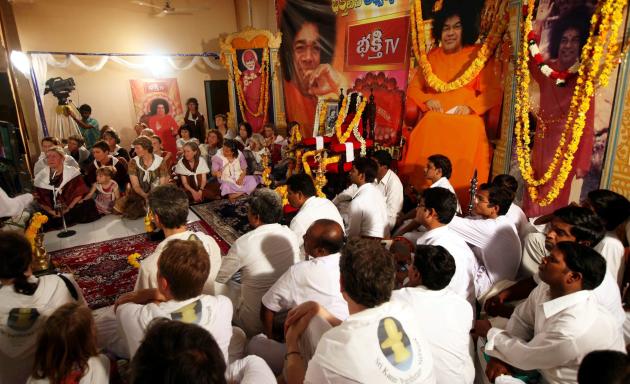
10.21 am: Devotees from around the world have been pouring in over the past week. Special arrangements are being made to accommodate thousands more devotees in the town.

10.15am: The AP chief minister is on his way to Puttaparthi.

10.00 am:Spiritual leader Sathya Sai Baba dies this morning around 7:40am. His body will be shifted to his ashram. Sai Baba's body will lie in state for two days.

A complete shut down has been called for at Puttaparthi.

Sai Baba was hospitalised on March 28. He died of cardiac and respiratory failure. He was 85.
Sathya Sai Baba dies - Live updates - Yahoo! News

Chitika