Sunday, May 15, 2011 8:58 PM
Another Milestone For Twitter As @LadyGaga Becomes First User To Reach 10 Million Followers - AllTwitter

I speculated on which of them would be the first to reach 10 million. Gaga had the lead, but Bieber was closing in fast. I suggested Gaga might hit the mark around May 23-24, but she’s beaten me – and Bieber – to the punch, as she’s now officially the first and founding member of Twitter’s 10 Million Club.
The milestone was reached about midnight ET, and Gaga celebrated in her usual style.
It’s another big milestone for Twitter, too. Ashton Kutcher was the first user to reach a million followers (way back in April, 2009). Charlie Sheen was the fastest, and Beyonce got there without writing even a single tweet. But being the first to 10 million puts Gaga in a different class entirely. Gaga has over 34 million fans on Facebook, but the network there is well over three times the size of Twitter’s, so like-for-like she’s on a par. Bottom line: she’s the biggest and most popular celebrity on the planet.

At least for the moment. Bieber is still catching up fast, as this chart from TwitterCounter shows.

I’d certainly expect to him to secure the number one spot later this year. Whether he can hold on to it is a different matter entirelyAnother Milestone For Twitter As @LadyGaga Becomes First User To Reach 10 Million Followers - AllTwitter
Wednesday, May 4, 2011 11:01 PM
Exclusive: Facebook and Google mull Skype deals | Reuters
Facebook Chief Executive Mark Zuckerberg has been involved in internal discussions about buying Skype, according to one of the sources. Another source said Facebook had reached out to the Luxembourg-based company about forming a joint venture.
Google has also held early talks for a joint venture with Skype, the second source said.
A Skype deal could be valued at $3 billion to $4 billion, the first source said. Skype's IPO is expected to raise about $1 billion, several other sources said.
The discussions are in early stages, and it is not clear which option the companies favor, the first two sources said.
Although an IPO is still in the cards for the second half of 2011, Skype remains in strategic discussions with other companies, two of the sources said.
Skype and Google declined to comment. Facebook was not immediately available to comment. The information is not public and the sources declined to be named.
Last August, Skype filed a registration statement to go public. The October appointment of a new chief executive, Tony Bates, a former senior vice president of Cisco Systems (CSCO.O), put the eagerly anticipated IPO on hold until the second half of 2011.
But rivals including Apple Inc (AAPL.O) and Google have marched into Skype's territory, undercutting the value of the pioneer service.
Although Facebook and Skype would benefit from each other's large community of users, neither has proven revenue models, said a separate source familiar with the companies.
For Skype, the clock is ticking, as large social media and software companies pour into the public markets.
On Wednesday, shares of Renren Inc (RENN.N), China's largest social networking company, surged nearly 57 percent in its first day of trade.
LinkedIn said on Wednesday that it would list its shares on the New York Stock Exchange. The social networking site for professionals filed to raise up to $175 million in an IPO expected later this year.
The flood of Internet public offerings this year will give Skype backers a clearer sense of its prospects, another source said.
"When a company is not going public and it has been on file for a long time, one way or another something is going to happen," that source said.
(Reporting by Nadia Damouni and Clare Baldwin in New York; Editing by Kenneth Li and Robert MacMillan)
Exclusive: Facebook and Google mull Skype deals | Reuters

Friday, April 29, 2011 1:45 AM
Can Facebook make you a better college student? - Career news


When it comes to India, the country's Facebook population has crossed the 25 million base mark. And among all the age groups, the younger generation between the age group of 18-25 has formed 53 percent of the total number of Facebook users in India. Apart from that, most of the Indian college campuses today are covered by WiFi networks and students use much of the bandwidth on social networking sites like Facebook and Twitter. Hence, the effect this has had on students has been an issue of heated debate.
The infographics below are an attempt to figure out the positive and negative aspects of social media among the student in U.S.
Here, the emphasis is on how social media affects student's grades. It shows that classes that use twitter typically have grades up half a grade point. It is also directly tied to students collaborating online with 75 percent saying that they would engage in online collaboration. What is surprising is that students who try to multitask between Facebook and studying are having lower grades.
Next
Can Facebook make you a better college student? - Career news
Thursday, April 28, 2011 10:10 AM
Tell Your Gullible Relatives Not To Click On Any Banned Lady Gaga Video Links


Sophos details the specifics of the attack but it notes that even the Lady herself is quite upset:
This is after her own Twitter stream began sending out the infected Tweets including one mentioning Shakira. It seems most of the Tweets are in Spanish so it may reduce the virality of the worm in English-speaking countries but it’s an interesting attack vector nonetheless – and you can be positive someone will try this trick again in multiple languages. Just remind your relatives not to give out their Twitter credentials to random websites. Also remember that you can revoke access to any app from your account page although, sadly, you can’t call them on your telephone, ya-ya-ya-your telephone.
Tell Your Gullible Relatives Not To Click On Any Banned Lady Gaga Video Links

Wednesday, April 27, 2011 3:14 AM
LinkedIn’s Mario Sundar on getting the most out of your network

LinkedIn is often viewed as a recruiting or job-seeking tool. Do you think people are underestimating its utility?
Sometimes. I do think professionals are growing in their understanding of LinkedIn’s benefits as the site grows mainstream.
I often say, “Ask not what LinkedIn can do for you, but rather what you can do with LinkedIn.” I use it constantly as my social Rolodex (constantly updating it with the help of the e-mail plug-ins we’ve got). Also, I can’t think of a more effective asset than LinkedIn Advanced Search. It helps me tap into my professional network for answers.
Two highly underrated solution-finding tools to help us get to solution mode happen to be Groups and Answers. Personally, I’m on Groups every day to find out what my colleagues at work are talking about. There is also potential for you to either create a group or participate in one where your colleagues, peers, clients, prospects gather.
Between Facebook, Twitter, LinkedIn and others, the market for networking platforms is pretty crowded. How can someone stay active on all of these accounts and still expect to be productive?
Good question. For starters, I’d just stick with the mature social-networking sites that have critical mass.
Here’s how I find value from the top three social-networking platforms:
- Facebook: I use this to derive social value from my close-knit circle of family, friends and peers I’m social with.
- LinkedIn: It’s a huge time saver when it comes to helping me find the right people, get answers to questions I grapple with in my daily job. It’s my social Rolodex, my idea factory, my resume and my people database.
- Twitter: As a blogger, this is a great marketing and distribution platform. Also, as social media lead for LinkedIn, I find our Twitter and Facebook presence is an an effective distribution channel for our blog content.
Do you think the social media profession is starting to gel? In other words, are objectives and expertise that companies can expect from social media experts becoming more clear?
It’s fascinating how the social media professional’s job is evolving over time.
I see the social media strategist role headed in two possible directions: seamless integration within existing functional areas and the emergence of an executive-level social media role.
So, yes, there’s increasing clarity on what companies can expect from social media strategists. On the one hand, they’re helping make existing functional areas more effective and efficient. The other hand, they have a senior role that applies the utility of social media across all functional areas.
To learn more top tips and best practices for social media from industry experts like Mario and others including Guy Kawasaki, Brian Solis, and Jeremiah Owyang, register for the the 100% online Social Media Success Summit. For access to the whole session and many others, sign up here. (SmartBrief is a partner in this event.)
Image credit: gehringj, via iStock Photo
LinkedIn’s Mario Sundar on getting the most out of your network

Facebook Deals Takes Aim at Groupon and LivingSocial - NYTimes.com
 Image via CrunchBase
Starting Tuesday, Facebook is releasing Deals as a “test” in five cities: Atlanta, Austin, Dallas, San Diego and San Francisco. The company, which has more than 600 million members, said it hoped that its ability to tap directly into the communications and activities of networks of friends will help it offer a more compelling service than rivals. It will be easy to share deals with friends, see when a friend buys something and find offers that your friends are interested in, said Emily White, Facebook’s director for local. Facebook will focus on offers for things that are best done with friends, like concerts or events, she said.
“You can receive Facebook deals via e-mail,” she said. “But if there is a deal that is good for you, it will likely show up in your news feed at some point in the day.”
While many other coupon sites allow users to log in with their Facebook name and share deals with friends, Ms. White said Facebook Deals would become more tightly woven into the site.
“A lot of deal sites get that deals are social,” Ms. White said. “But I wouldn’t say they are really well integrated with Facebook.”
Facebook’s plan to introduce a rival to Groupon and LivingSocial has long been known. Last month, the company began allowing users who want to receive offers via e-mail to “Like” the Facebook Deals service.
Deals may well be a boost to another important Facebook program: Credits, the company’s virtual currency. Users will be able to buy Deals with a credit card or with Credits. Until now, Credits could only be used to buy virtual goods inside games and some digital products like movie rentals.
“It is first time it has been used to purchase a voucher that is redeemable for real goods,” Ms. White said. Facebook has made no secret of its plans to turn Credits into a major force in online payments.
Facebook will rely on its own sales force to find businesses interested in offering Deals. It will also tap other services that offer deals, including OpenTable, which focuses on restaurants, PopSugar City, which tailors offers to women, and Zozi, which focuses on outdoor activities like kayak excursions or wine-tasting tours.
Facebook Deals Takes Aim at Groupon and LivingSocial - NYTimes.com

Sunday, April 24, 2011 9:08 AM
Q&A With Survivor Host Jeff Probst On Surviving Social Media

The CBS show Survivor is completing its 22nd season—a run with a business and social impact that are reserved for extraordinarily few productions in Television history. Survivor launched the Reality TV genre and has managed to continue to do well during a decade where the very foundations of TV have been shifting. The show’s host Jeff Probst has been a mainstay and a driving force behind the show’s continued innovation in storytelling. I recently caught up with him to get some unfiltered thoughts. If you have questions or comments you can direct them to @jeffprobst on Twitter!
Read more...
Q&A With Survivor Host Jeff Probst On Surviving Social Media


Sunday, April 17, 2011 8:53 AM
Using Facebook Photos to Meet Women

Therefore, to be desirable on Facebook, you need to have an attractive Facebook picture.
Read More..(www.mensxp.com)Using Facebook Photos to Meet Women

Friday, April 15, 2011 3:12 AM
Leading app maker said to be planning Twitter competitor - CNN.com
The service would seek to attract users by addressing common complaints about Twitter, such as its restriction on the length of a message and how it can be confusing to newcomers, according to these sources, who were not authorized to speak publicly about the plans.
UberMedia is a leading developer of apps and Web-based services that help users communicate on Twitter and other social media platforms. The Pasadena, California-based company has amassed a small empire of apps -- among them UberSocial, Echofon and Twidroyd -- that connect to Twitter and offer features beyond Twitter's own software.
Together, those UberMedia programs accounted for about 11.5% of tweets sent on one day last month, according to a study by market research firm Sysomos. UberSocial is the third most-popular way to send tweets, behind Twitter's website and official iPhone app, the study found.
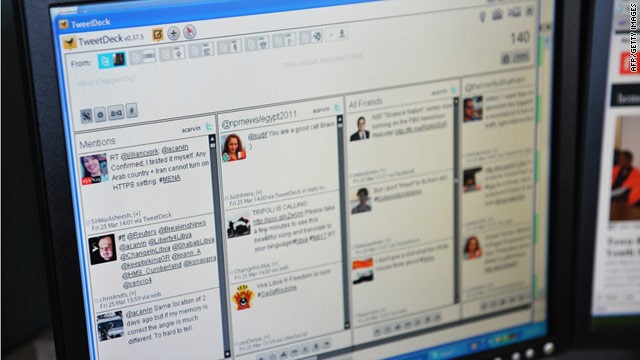
TweetDeck is tied with Twitter's own BlackBerry app as the fourth most-popular software for sending messages, Sysomos said. UberMedia is in talks to acquire TweetDeck, but that deal hasn't been finalized, according to a person familiar with the matter. Industry website TechCrunch first reported on the talks.
"The audience for TweetDeck is very different" from the people who use Twitter's official apps, Tony Haile, a general manager for Betaworks, said a year ago. The technology incubator is where TweetDeck started. "We never competed on core functionality."
Twitter has experienced rapid growth since its launch five years ago and now has about 200 million registered users. Last week, Twitter said users were sending 155 million tweets a day, a 282% increase over a year ago. Sign-ups over the most recent quarter were up 52% compared with the year before, Twitter said.
Twitter competitors such as FriendFeed or Google Buzz have failed to catch on with mainstream users -- although some, like Tumblr, are growing.
Nine out of 10 people actively using Twitter access the service through the website or an official app at least once a month, Twitter wrote last month in a memo to third-party developers.
That memo caused a bit of an uproar among developers, who were unhappy that Twitter was discouraging them from developing standard client apps. Twitter has instead asked independent programmers to build software that presents Twitter data in unique ways, such as mashups, rather than showing a conventional list of messages from followers.
Developers took to blogs and message boards to vent, accusing Twitter of abandoning the unpaid evangelists who helped grow the service early on.
A Twitter spokesman declined to comment, but executives say they're trying to guide developers toward a path that doesn't duplicate the functions Twitter already offers.
Twitter held a conference around this time last year called Chirp, aimed at developers, where it launched the first official apps for smartphones. Mobile was previously a niche reserved for third-party developers, and they were put off by Twitter seemingly encroaching on their territory. Twitter has not said whether it will hold a Chirp event this year.
The relationship between Twitter and UberMedia appears to be especially strained.
Twitter temporarily shut out three of UberMedia's apps in February, saying they were in violation of company policies. Twitter asked UberMedia to change the name of one of the apps, formerly called UberTwitter and now UberSocial, said UberMedia CEO Bill Gross.
UberMedia's proposed Twitter competitor could be a backup plan, implemented only if the relationship with Twitter becomes untenable, said a person familiar with the matter. Gross, who sources say has been briefing people on the project for months, declined requests for interviews through a spokesman.
"Our foremost desire is to continue to innovate on the Twitter platform and bring more users and usage to Twitter," UberMedia marketing chief Steve Chadima said in a statement.
A competing short-messaging channel from UberMedia could succeed where others, like Jaiku, have struggled. Because UberMedia's apps reach a significant portion of Twitter's audience, many of whom are power users, the new service could sway some influential people.
TweetDeck asks users to sign up for an account separate from their Twitter handle in order to synchronize their windows between mobile and desktop platforms. With an account, they can also post to a service called Deck.ly, which allows messages longer than Twitter's 140-character limit.
Adopting other platforms, such as Facebook and homegrown networks, is a sensible strategy, said Jeremiah Owyang, an industry analyst for research firm Altimeter Group. Twitter may risk losing support from developers unless it finds a way to properly articulate its strategy and the reasons for changes to policy, he said.

Tuesday, April 12, 2011 11:09 PM
Just How Reputable Is DLA Piper, The Law Firm With The Client Who Says He Owns 50% Of Facebook?

It's got lots of new evidence in it: mostly emails between Ceglia and Zuckerberg.
Facebook's response so far has to been to claim that Ceglia's evidence is all fabricated (and to remind everyone that Ceglia is an ex-con).
Our question is: how reputable is DLA Piper? Are they the kind of place that would take a document fabricator on as a client?
We asked around, and here's what we heard:
- Gawker operations boss Scott Kidder told us: "They are very well respected."
- An IP lawyer we know said: "Very large. In the top 50."
- They were thirteenth highest-grossing law firm, according to Law.com.
- A person in the startup scene said: "DLA Piper has an excellent reputation in the tech industry. I've talked to a lot of people about a lot of firms and they've never said anything but positive things. "
- We hear DLA Piper is Los Angeles-based VC Mark Suster's firm.
- A guy from super fancy law firm Skadden tells us "an IP guy (a much more experienced associate) said he didn't think the IP group was particularly well-regarded."
Just How Reputable Is DLA Piper, The Law Firm With The Client Who Says He Owns 50% Of Facebook?

Friday, April 8, 2011 2:25 AM
Will Facebook Ever Be an E-Commerce Powerhouse?: Tech News and Analysis «

According to Mulpuru, who surveyed dozens of retailers large and small about their use (and/or their lack of use) of Facebook as a retail sales channel, “while pockets of opportunity for Facebook do exist, the likelihood that Facebook will ever be ‘the next Google,’ thereby becoming a key sales-driving tool for retailers and creating a reliable revenue stream for Facebook, is unfortunately far-fetched.” Why? The Forrester analyst says that Facebook-based stores are largely ineffective, especially for larger retailers, and that click-through rates are also anemic. In a nutshell, the analyst says:
In spite of the fact that hundreds of millions of people around the world have Facebook accounts, the ability of the social network to drive revenue for eCommerce businesses continues to remain elusive. eBusiness professionals in retail collectively report little direct or indirect benefit from Facebook, and social networks overall trail far behind other customer acquisition and retention tactics like paid search and email in generating a return on investment.The report’s findings show most retailers are still just experimenting — in some cases because they feel that they should — and social networks still rank dead last in customer-acquisition tactics, with 7 percent of those surveyed saying they use them, compared with 90 percent for search-engine marketing. According to the retailers Forrester talked to, social networks are barely any more effective than run-of-the-mill banner advertising, in part because click-through rates are low (1 percent, compared with a click-through rate of about 11 percent for email marketing). Facebook stores also don’t perform well, and some retailers say the network tries to push retailers towards banner ads instead.
Taking advantage of Facebook’s open graph — through “like” buttons but also the sharing of shopping activity with one’s network, etc. — is useful, but is really only effective when there is a large enough network of users doing this, says Forrester. This fact “ultimately renders the Open Graph (and the specific value of Facebook) inadequate for all but the very large companies” such as Amazon. And while companies can get a lot of data from Facebook about customer interaction, comments, behavior and so forth, Mulpuru says that “the unstructured nature of data from social networks… makes it difficult for even the most sophisticated natural language processing tools to shape meaningful conclusions.” In other words, there’s lots of data but it’s not very useful.
Forrester says there are many who benefit from Facebook — including “small, pure plays” for whom Facebook is like “the 2011 version of Yahoo Merchant Solutions or eBay ProStores,” in that it allows anyone selling something to set up shop and market themselves relatively quickly. These kinds of enterprises, as well as local and community-based companies, often benefit the most from the word-of-mouth advertising that social networks specialize in. Other things that work well are categories that have a tendency to “go viral,” such as movies or books and other forms of digital entertainment, anything that sells well in a peer-to-peer marketplace (in which Facebook effectively competes with Craigslist) and of course anything related to online gaming.
Read more
Will Facebook Ever Be an E-Commerce Powerhouse?: Tech News and Analysis «

Thursday, April 7, 2011 9:01 AM
State Farm Says 'Hola' to Latinos on Facebook | ClickZ

Here are two music-minded examples from the 28 Facebook threads started by the Bloomington, IL-based company so far:
Latin singer and composer Gustavo Galindo spent the day teaching students about teen driver safety at DeWitt High School in New York. This was the first "Celebrity Music Teacher for a Day", a multi-city program created by State Farm in conjunction with the Latin Billboard Award concert series. Check it out!
(Vía Premios Billboard-Telemundo) ¿Ya votaste por tu artista favorito a Premio Tu Mundo? ¿Qué estás esperando? Puedes votar cuantas veces quieras!! http://ow.ly/4sHSk
The latter post represents a partnership that State Farm has forged with both the Spanish-language cable channel Telemundo and the Latin Billboards music awards show. The insurance firm is encouraging Facebook users to visit Telemundo.com to enter a contest to win a trip for two to attend the Latin Billboards in Miami on April 28.
State Farm's "likers" can also employ a State Farm Facebook Latino app to enter to win three music downloads.
In an announcement today, Tim Van Hoof, State Farm director of marketing, cited 13.5 million Hispanics on Facebook as a key reason for launching the dedicated page on the social site. "Due to the increasing number of Latinos who use Facebook on a daily basis, we have created an online meeting point where all U.S. Hispanics who are fans of State Farm can share or express their ideas and opinions, become informed or just spend a pleasant time with us, in the language of their choice," he said.
State Farm Says 'Hola' to Latinos on Facebook | ClickZ

Tuesday, April 5, 2011 8:57 PM
Twitter to offer brands Facebook-style pages - Marketing news - Marketing magazine
 |
| Twitter is considering creating Facebook-style branded pages as part of its drive to increase its revenue from advertising. |
It is understood that Twitter chief executive Dick Costolo, and Adam Bain, president of revenue, are leading the push to create fresh revenue streams.
The pages would work in a similar way to Facebook Pages, providing brands with their own space to deliver content and encourage Twitter users to follow them, claim sources.
There are currently limited promotional opportunities for brands on Twitter. Apart from free branded accounts, it offers Promoted Accounts that allow brands to buy a place in recommended followers’ lists and sponsor hashtags, so they appear in relevant searches.
Any launch of branded pages would roll out first in the US. Twitter launched its first ads on the platform in the US in April 2010, where its partners include Starbucks, but has yet to offer such opportunities in the UK.
A spokesman for Twitter confirmed that ‘strong interest’ from brands meant it is now looking to set up a UK office. He declined to comment on specific advertising plans.
Fore more news vistit www.marketingmagazine.co.u
Twitter to offer brands Facebook-style pages - Marketing news - Marketing magazine

Obama Opens 2012 Campaign on Facebook - Techland - TIME.com

Why on Facebook? Well, which politician wouldn't want to post a two-line announcement and get nearly three and a half thousand responses within an hour? (The total at the time of writing was 3,398, but it'll be much bigger by the time you read this.)
The web played a big part in the last election, but you can be pretty sure it's going to be even more intense next time around. Back in 2010, Twitter was just big. By 2012, it's going to be huge.
And even that won't be anything like the vast reach offered by Facebook. Love it or hate it (and there are plenty of people who hate it, but they're not on Facebook, so their views get drowned out by all the Facebook-likers), no other website or social network has a chance of reaching so many people at such speed.
Obama just opened the floodgates. Politics is going to be a huge thing on the world's hugest social network for the next couple of years.
Obama Opens 2012 Campaign on Facebook - Techland - TIME.com

Monday, April 4, 2011 9:10 AM
Making Facebook Ads More Buyer-Friendly - WSJ.com

In February, more than a third of all online-display ads in the U.S. appeared on Facebook, according to comScore Inc. That's more than three times as many as its closest rival, Yahoo Inc., had.
But Facebook doesn't come close to capturing a third of the online-ad budgets of major marketers, partly because its ad rates are relatively low, and also because of its hard-to-navigate in-house systems for buying ads.
Enter a new set of specialized Facebook agencies that seek to offer an easier way to buy ads on the social-networking site. The emergence of more than a dozen firms, including Blinq Media LLC, Kenshoo Ltd. and Web-trends Inc., follows a move by Facebook in 2009 to start opening direct access to its internal ad systems to select outsiders.
The Facebook agencies sell marketers the ability to manage the buying of thousands of different versions of their ads, with varying text and images. They also make it easier for advertisers to buy ads targeted at niche groups of consumers, based on their ages, locations, interests and other factors. The agencies also offer tools that track the performance of an ad campaign, such as how many users click on the ads or become fans of the brand on Facebook.
Blinq Media Chief Executive Dave Williams started his firm in 2008, predicting that a new advertising "ecosystem" would emerge tied to Facebook, and that marketers would need help to buy ads on the site, just as new agencies cropped up about a decade ago to help the marketers buy ads on search engines.
"With search, advertisers can match their ads to user intent. With Facebook, advertisers match their ads to user interests," said Mr. Williams, who previously co-founded the search marketing firm 360i, now owned by Dentsu Inc. "It's like fishing."
Facebook said it welcomes the specialized agencies because they bring in new customers and can handle large-scale campaigns. "The ecosystem that these third parties are developing and building on Facebook is healthy and of benefit to everyone," said David Fischer, Facebook's vice president of advertising and global operations. Already, he said, he is seeing signs that agencies are encouraging big marketers to spend more.
While Facebook's own ad-sales team sells premium ads directly to big marketers, much of its inventory is sold through a self-service tool built by the website. The tool lets marketers create an ad by manually inserting text and images, then selecting targeting features, such as the location, age and interests of users they want to reach.
But Facebook's in-house system is unwieldy, ad executives say, especially for big brands, which often want to place thousands of versions of their ads, with different texts and images, to target different audiences.
"It wasn't built with large advertisers in mind," said Michael Brunick, vice president of strategic partnerships at Interpublic Group of Cos.' digital-ad buying unit Cadreon, whose clients include Chrysler Group LLC and Verizon Communications Inc. Mr. Brunick said his agency doesn't buy any Facebook campaigns for its clients at present.
"The infrastructure is still in its infancy," said Rob Griffin, a senior vice president at Havas Digital, part of French advertising group Havas SA. "It makes working with them very challenging." Havas Digital recently signed a deal to work with Blinq.
Deals website Groupon Inc. said it was placing its Facebook ads manually until four months ago, but could turn out only a couple of dozen different ads a day using the self-service system. Now it has hired Facebook specialist AdParlor Inc. to navigate the system and can churn out thousands of ads a day targeting narrow-niche demographics like 27-year-old women in South Carolina who like yoga.
Technology from Blinq Media helped restaurant chain Buffalo Wild Wings identify groups of likely customers beyond its ordinary target audience of college football fans who would respond to its campaign. That tripled the campaign's return on investment, said David Rollo, senior vice president of digital and social strategy at 22squared, an agency that brought in Blinq for help.
While the specialized agencies can help with the problem of placing ads, it isn't clear whether that will do much to raise ad rates on the site, which have been damped by a flood of inventory and marketers' wariness about the effectiveness of ads on such sites. However, by increasing demand and making it easier to target ads and measure their performance, the specialized agencies could improve Facebook's rate equation.
Some of the smaller agencies have ended up selling their services to larger ones. Blinq Media has attracted business from firms including Havas Digital, Publicis Groupe SA's Moxie Interactive and privately held 22squared.
Some large ad companies, however, say they would like their own direct access to Facebook's systems so that they can build ad-buying tools that they might merge into their existing systems, and better evaluate how ads on other websites compare with Facebook ads. "We want to have the relationship with Facebook directly," said Cadreon's Mr. Brunick.
Facebook's Mr. Fischer said his company plans to expand access to its technical infrastructure, but the small, technologically oriented agencies were a natural place to start. "They are able to move fast," he said

From #SXSW: Can you demystify privacy and empower your digital identity?
This post is by Shaun Dakin, founder of @PrivacyCamp and fellow at the Future of Privacy Forum.
Data privacy is hot right now. With the rise of social media and Facebook at the center of the “social layer,” we are just starting to think about data privacy. Consumers are confused, and the regulators are concerned as well.
How important is this topic? Sens. John Kerry, D-Mass., and John McCain, R-Ariz., have held hearings about online privacy and an online privacy bill of rights. Last year, the FTC and the Department Of Commerce each released major reports on data privacy.
So it was great to watch a panel featuring Nick Goggans of Umbel, Arbitron’s Paul Krasinski and Microsoft’s Marc Davis at the South by South by Southwest Interactive Festival, as they discussed this pressing issue.
The bottom line in the States is that there are no unified regulations around privacy. There are financial services, health care and online children laws. There are few that apply to the brave new world of social media.
Two of the big ideas discussed during the panel:
- Zuckerberg’s Law: Every year, you share twice the amount of data than the year before.
- Marc Davis’ claim that we live in an age of “digital feudalism” in terms of who owns our data and online identities.
From #SXSW: Can you demystify privacy and empower your digital identity?
Sunday, March 27, 2011 7:52 AM
Facebook Rolls out 'Facebook Questions'

The application, accessible from your homepage, lets you ask questions and get prompt replies from your friends and other people. When you ask a question it is shown in your news feed. If your friends answer or follow that question, it will be shared with their friends and so on.
Tuesday, March 22, 2011 9:27 PM
On Twitter, Conservative (or Liberal) by Association - NYTimes.com

Their research stems from an effort to rank 2010 primary candidates by political ideology. The researchers — David B. Sparks, Frank J. Orlando and Aaron S. King — analyzed whom politicians were following on Twitter, and who followed them. They then ranked the politicians on a political spectrum from the far left to the far right; the results dovetailed with ideological ranking systems based on the politicians’ voting records.
The idea that someone could divine the political ideology of someone who is using Twitter as a political tool is hardly a surprise. But Mr. Sparks said what was surprising about their study was that even public figures who are not openly political, and private citizens who use the site primarily as a social tool, reveal their political leanings through whom they choose to follow, and who follows them.
